At a Glance
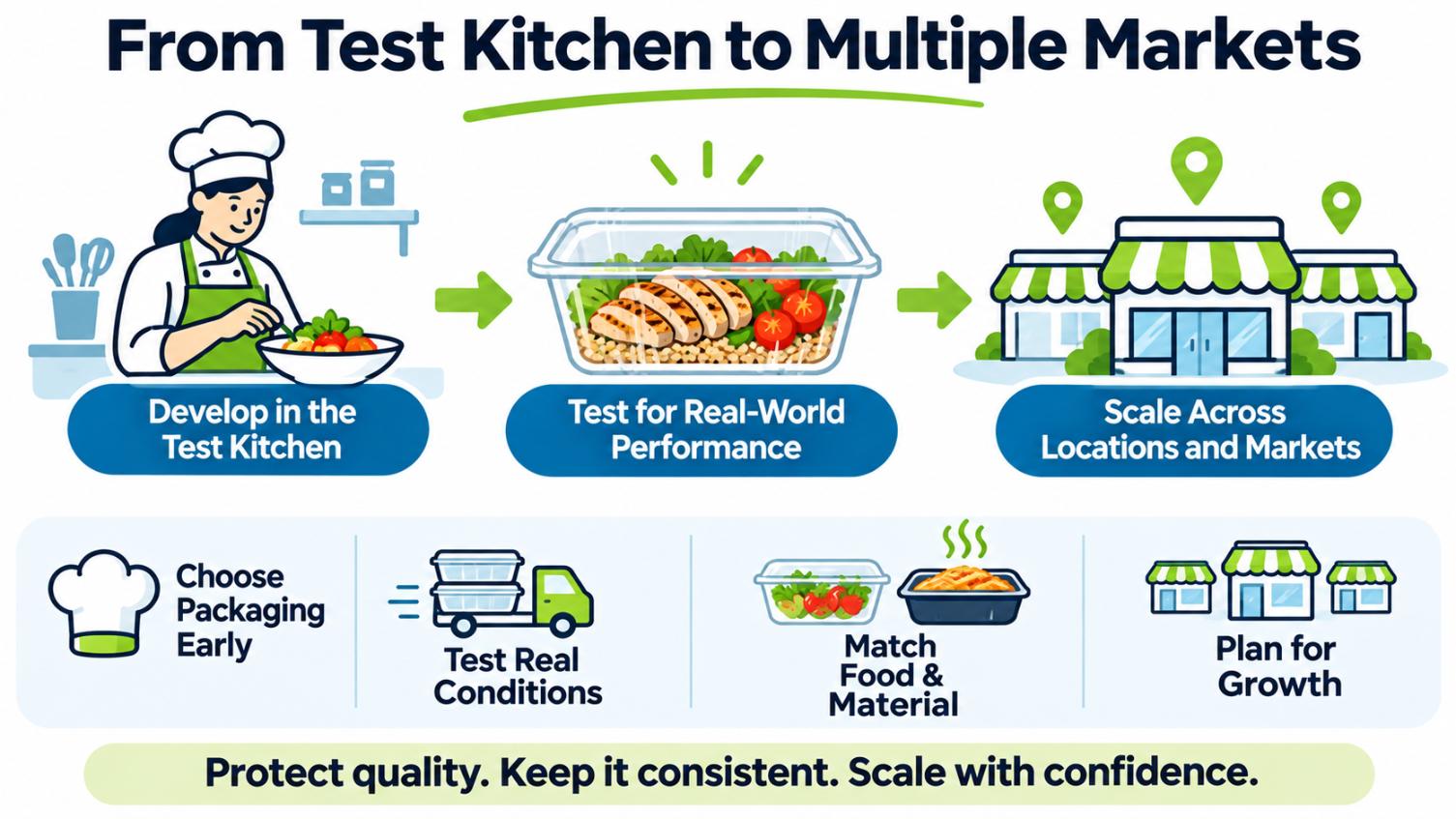
- Bring packaging into menu development early: Choosing a container while developing a new food item can help avoid costly changes before launch.
- Test packaging under real-world conditions: Filling, stacking, holding, transporting, and reheating can reveal problems that a test kitchen may miss.
- Match the package to the food: Materials, temperatures, portions, closures, and presentation all affect how well packaging performs.
- Plan for growth and consistency: Clear packaging specifications, reliable suppliers, and input from Operations and Supply Chain can help food businesses expand into new locations and markets.
Creating a new menu item is exciting. Scaling it across 50, 500, or several thousand locations is where things get…well…interesting.
In the test kitchen, you can control nearly everything. The ingredients are right where you need them, an experienced culinary team prepares the food, and someone is usually standing nearby to adjust if something doesn’t look quite right.
Then commercialization arrives. This is when you may need to take a deep breath.
Suddenly, the recipe needs to work with different employees, equipment, production volumes, and distribution networks. The food still needs to look and taste the way the culinary team intended. And somewhere along the way, somebody needs to decide what package will carry it through all of that.
At Inline Plastics, we’ve provided packaging solutions to fresh food businesses for over 55 years. We’ve learned that packaging decisions are easier when they happen early in development. Waiting until launch to ask, “What are we putting this in?” can lead to some very creative meetings (and no, by “creative,” we don’t mean suggesting you put the food in an old shoe and hope for the best).
In this article, we’ll explore how culinary and R&D teams can choose packaging that performs beyond the test kitchen, supports consistent food quality, and grows with their business.
When Should Packaging Enter the Menu Development Process?

The ideal answer is while the menu item is still being developed.
Packaging can affect portioning, presentation, holding, transportation, reheating, and how consumers experience the food. Discovering those needs late may force the culinary team to change the food to fit the container.
Start by asking how the item will be served. Will it be packaged hot or cold? Does it contain sauces? Will consumers reheat it? Do ingredients need to stay separated? How long will it remain packaged?
These answers help determine the material, size, shape, and closure you need. For example, a pasta dish with plenty of sauce meant to be reheated would require microwave-safe material (more on this to come), a leak-resistant seal for that sneaky sauce trying to get out, and a clear presentation so shoppers can see how incredible the offering looks.
After all, changing a container during development is much easier than changing one two weeks before launch.
Will the Package Perform Outside the Test Kitchen?
A package that works during a culinary tasting has passed one test.
Unfortunately, commercialization has several more waiting.
The food may be prepared by different employees, stacked in storage, transported, refrigerated, or reheated. Each step can affect packaging performance.
That’s why testing should reflect real operating conditions, not just how a container looks on a conference-room table.
Fill it with the actual food at the expected temperature. Have employees close it using the normal process. Stack and transport it. Hold it for the expected amount of time, then check for leaks, damage, condensation, or changes in presentation. If reheating is part of the plan, test it using packaging designed for that purpose.
Testing should also consider food safety and shelf life. A secure closure may help protect the product; however, it doesn’t replace proper sanitation, temperature control, or shelf-life testing.
Does the Packaging Material Match the Food?
 Not all plastic containers are designed for the same job.
Two common plastics used in fresh food packaging are polyethylene terephthalate (PET) and polypropylene (PP). Each has different properties that make it better suited for certain foods and uses.
PET is often used for cold and ambient foods when visibility matters. Clear PET lets consumers see fresh salads, produce, and other foods before buying.
PP offers greater heat resistance and is a commonly used material for microwave-safe food containers (told you we would get back to this). However, the material alone doesn’t determine whether a container is suitable for a specific use.
You also need to consider the food itself, filling conditions, storage requirements, and intended reheating method. Hot filling, moisture, oils, and sauces can all affect which package is appropriate.
The question shouldn’t simply be, “Which container fits?” It should be, “Which container fits what this food needs to do?”
A refrigerated salad and a hot entrée might look equally happy in the test kitchen. Even though the dishes may seem like great pals who do everything together, they probably shouldn’t share the same packaging requirements.
Can Packaging Support Consistent Portions and Presentation?
When a menu item expands, consistency becomes harder.
A culinary team may know exactly how the finished dish should look. At the same time, restaurant employees need a process they can repeat during a busy lunch rush.
The right container can help. A properly sized package can provide a visual reference to employees for portions and presentation. If it’s too large, the food may look sparse. If it’s too small, ingredients can become crowded, and the lid may be harder to close.
Compartments can also help keep ingredients separated when the food requires it. While packaging can support portion control and employee training, it can’t replace them.
The recipe tells employees what to make. The package helps them deliver it the way the culinary team intended.
What Happens When the Menu Item Enters a New Market?
 Expanding into new markets introduces challenges that may not exist in the original test kitchen.
The same container may not be available in every region. Suppliers, production capabilities, transportation needs, and local packaging regulations can differ. If you’re expanding internationally, you’ll also need to confirm that your packaging materials meet the food-contact requirements of each destination market. A container that works well in one country may still need additional compliance review before being used in another.
These differences make clear packaging specifications even more important. Rather than simply asking another supplier for something similar, identify the features that cannot change.
Does the package need the same internal dimensions, closure performance, temperature resistance, or product visibility? Which features are essential, and where is there room for flexibility?
If an alternative container is needed, test it under the same conditions as the original.
Otherwise, “find something similar” can become an unexpectedly adventurous specification.
Can Your Packaging Supply Keep Up With Demand?
A successful limited-time offer (LTO) creates a good problem: Suddenly, everyone wants more. And if the packaging demand grows faster than expected, you may have a not-so-good problem.
Before launch, ask your supplier about production capacity, lead times, shipping locations, and backup plans. Consider how case quantities, storage space, and transportation affect the operation as volume increases. These questions become even more important when an LTO becomes a permanent menu item.
A container that performs beautifully isn’t that helpful when it’s unavailable when you need it. After all, consumers can’t order your newest creation if you can’t package it.
How Should Culinary and R&D Teams Make the Final Decision?
 Start with the food and follow its entire journey, from preparation to the consumer’s hands.
Bring Operations, Quality, and Supply Chain into the conversation early. Each team sees different risks, and those perspectives help build a stronger packaging plan.
Before approving a container, make sure you’ve answered these questions:
- Does it protect the food and support the intended presentation?
- Does it perform during filling, holding, storage, transportation, and intended reheating (if applicable)?
- Can employees fill and close it consistently during busy service?
- Can suppliers support the required volume and markets?
- Has it been tested with the actual food under real operating conditions?
- Does the package meet applicable food-contact requirements in every market where it will be used?
No single container will solve every operational challenge, yet choosing one based on these requirements can help reduce surprises as the program grows.
This Little Package Goes to Market
Scaling a menu item means turning a culinary idea into something hundreds or thousands of employees can prepare and serve consistently.
The right packaging supports that process by protecting the food, maintaining the intended presentation, and fitting the way each location operates.
It gives your teams one more tool to deliver the same great food experience, whether you’re serving consumers at your first location or your five-hundredth.
Ready to find packaging that can grow with your next menu item? Talk to Us at Inline Plastics to explore packaging options and request samples for testing.