At A Glance
- Black plastic food packaging isn’t one material: It can be made from several different plastics, each with its own properties and food-contact requirements.
- A widely reported black plastic study needs context: Its 85% figure applied to 20 selected high-bromine samples, not all 203 products screened. Two subsequent corrections changed exposure calculations.
- Food-contact packaging is regulated: FDA requirements depend on the substances involved, intended uses, potential exposure, and applicable authorizations.
- Recycling is another major challenge: Traditional carbon black pigments can interfere with sorting equipment, while limited end markets create additional obstacles.
Have you ever seen a short online video trying to convince you of something that made you question its accuracy? Sometimes an idea or product is presented that is too good to be true…and sometimes they try to scare the living daylights out of you in a short window of time. Unfortunately, it occasionally works.
Some information about a viral study has been making the rounds on social media, and it treats a black plastic takeout container like a Batman villain. Some of these claims suggest that black plastic food packages contain harmful chemicals, such as flame retardants and heavy metals, or are made from recycled electronic waste, like old computers. But do those claims apply to every black food container? Not so fast.
It’s frustrating to think that a short bit of content can strip away a lot of scientific context.
Getting to the Facts
At Inline Plastics, we’ve been providing packaging solutions to fresh food businesses for over 55 years. We’ve seen plenty of packaging concerns come and go, and we also know that packaging questions deserve more than a scary soundtrack and a 30-second explanation.
To get straight answers, we sat down with Conor Carlin, Founder and President of Clefs Advisory LLC. Conor works where packaging meets sustainability, bringing expertise in materials, technology, policy, strategy, and market intelligence. He served as President of the Society of Plastics Engineers in 2024 and previously led ILLIG in North America as General Manager.
Below, we’ll examine each claim individually: What researchers actually examined in the viral study, whether recycled electronics can contaminate other plastics, how regulators evaluate food-contact safety, and which black plastic problem poses a real concern.
Is Black Plastic Food Packaging Safe for Food?
 Some of the claims against the material are quite bold, including that black plastic food packaging contains dangerous flame retardants and heavy metals. The problem is, “black plastic” isn’t one material. It’s a color.
Manufacturers can make black food packaging from PET, polypropylene, CPET (the material behind many ovenable trays), polystyrene, and other materials. Lumping them together is like saying every red food is spicy because you once bit into a habanero that made steam come out of your ears. The resin, additives, source of materials, and intended use all matter when evaluating food-contact suitability.
What Did the Viral Black Plastic Study Really Find?
It was published in the journal Chemosphere and included researchers associated with Toxic-Free Future. Researchers tested several categories of household products, not just disposable food containers. Some styrene-based products were more strongly associated with the flame retardants measured than products made from polypropylene or nylon.
One of the most alarming claims circulating online is that 85% of black plastic products tested contained flame retardants. That sounds pretty concerning, right? But there’s an important detail missing from that statistic.
In the study, researchers screened 203 products for bromine, an element present in many brominated flame retardants. Think of it as a smoke alarm, not proof of fire. They selected 20 products with bromine above the study’s threshold for more detailed analysis, and 17 of those 20 contained flame retardants. The widely repeated 85% figure applies to that selected high-bromine group, not all 203 products. Quite a difference.
There’s another important distinction: The products studied included household items such as kitchen utensils and other consumer goods. The study’s dietary exposure estimate was based on a scenario involving contaminated cooking utensils. Readers should not interpret it as a measure of exposure from every black plastic takeout container.
Then there’s the math. The authors compared an estimated exposure to the EPA’s reference dose, an estimate of daily exposure likely to be without appreciable health risk over a lifetime. The original comparison contained a tenfold error (more on this below). Correcting that comparison placed the estimated exposure below one-tenth of the reference dose used in the study.
What Happened to the Study?
The researchers corrected the study twice. The first correction, published in December 2024, fixed the calculation error mentioned above that made the estimated exposure appear 10 times higher than it should have been. A second correction in 2025 lowered the estimated daily exposure to BDE-209, a type of flame retardant, from 34,700 to 7,900 nanograms. That’s a reduction of more than 75% from the original estimate.
The authors didn’t retract the study and maintained that its central findings remained intact. The corrections matter when interpreting the risk estimates, but they don’t erase the detection of flame retardants in some products.
Is E-waste Being Recycled into Black Takeout Containers?
 So where did the concern about recycled electronics come from? Some flame retardants used in electronics were detected in other household products, raising questions about how materials move through recycling streams. That makes source control especially important when recycled plastic is intended to contact food.
For recycled plastics intended for food-contact use, the FDA provides guidance on source control, contaminant removal, and intended conditions of use. For many recycling processes, manufacturers may seek a favorable opinion from the FDA regarding the suitability of the process for food-contact applications.
These controls aim to prevent manufacturers from using unsuitable or contaminated recycled materials in food packaging. They do not mean contamination is impossible, which is why sourcing and compliance documentation matter.
Want peace of mind? Ask your supplier for its food-contact compliance documents. A good one will hand them over without breaking a sweat, and you will see that no smartphone components are living inside your black plastic packaging.
Can Hot, Acidic, or Fatty Foods Make Black Plastic Leach Chemicals?
Here’s the one claim with a grain of truth. We need to emphasize the word “grain.”
Depending on the material and substances involved, heat, fatty foods, and certain food conditions can influence whether substances move from packaging into food. Scientists call this migration, and it isn’t limited to black plastic alone.
That’s why migration testing is an important part of evaluating food-contact packaging. Testing considers the type of food, temperature, and length of contact, often using conditions that simulate the most demanding expected use. Detecting migration does not automatically establish a health risk; the amount of exposure and the substance’s toxicological properties also matter.
But testing is only part of the picture. The FDA also evaluates food-contact substances based on their intended use, potential migration, dietary exposure, and toxicological safety. Rather than applying one universal migration limit to every substance, applicable authorizations can establish different conditions and limitations. Users must follow those requirements when selecting food-contact materials.
What Is an Actual Concern Regarding Black Plastic?
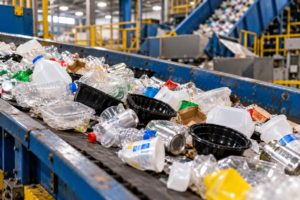 The real challenge with black plastic doesn’t involve poison.
When recycling is picked up, it’s brought to a Materials Recovery Facility (MRF) for sorting. These facilities often use near-infrared (NIR) scanners to identify different plastics. However, traditional carbon black pigments can make black containers difficult for these scanners to detect. As a result, sorting facilities may miss some containers and send them to disposal, even when consumers place them in recycling bins.
Emerging technologies, such as advanced scanning, can help, but they aren’t available at every MRF because each facility has different capabilities.
Scanner-friendly dark colorants already exist, but sorting is only half the job. Recycled material also needs an end market, meaning a buyer. Even when black plastic can be identified and sorted, end-market demand can be limited, particularly for certain colored PET thermoforms. Whether a container can actually be recycled depends on the resin, local collection and sorting systems, processing capabilities, and available buyers.
What Does This Mean for Your Food Business?
Before changing your packaging because of hype, ask your supplier a few important questions:
- Is the packaging suitable for my food? Confirm that the materials meet the applicable FDA food-contact requirements.
- Can it handle my intended use? Make sure the container is appropriate for the food, temperature, and length of contact.
- What recycled materials are being used? Ask how recycled content is sourced and evaluated for food-contact applications.
- Can the packaging actually be recycled? Consider the resin, pigments, local recycling capabilities, and demand for recovered material.
These questions can help you make packaging decisions based on evidence rather than headlines.
The Bottom Line, in Black and White
The headlines about black plastic deserve scrutiny, but so do the claims made in response to them. The study identified genuine contamination concerns in certain household products, although its findings don’t apply equally to every type of black plastic food packaging.
For food businesses, the best approach is to focus on what can be verified. Ask suppliers whether their packaging meets food-safety requirements, understand how the packaging will be used, and find out whether local recycling facilities can process the material. Those decisions are more valuable than reacting to what’s in your feed.
Need a hand? The Inline Plastics team can help you find packaging that keeps food fresh, looks great, and gives you one less thing to worry about next time something goes viral. Let’s talk!
Would you like to know more about Conor Carlin and his work at Clefs Advisory LLC? Connect with him on LinkedIn today.