
At a Glance
- Fixed weight means every package is priced the same, regardless of small differences in actual weight. Variable weight means each package is priced based on its exact weight.
- Fixed weight offers consistency but can lead to product giveaway through overfill.
- Variable weight lets you charge for exactly what’s in each package.
- Product type, labor, equipment, and consumer expectations all affect the right choice.
- The right container can improve efficiency and presentation either way.
It’s time to look at a pretty heavy question your food business may face: Do you sell by the package, or do you sell by the pound? It sounds like a small decision. It isn’t. It touches your pricing, labor, and freight every day.
Inline Plastics has been helping fresh food businesses solve exactly this kind of packaging puzzle for over 55 years, so we’ve seen the fixed-weight-versus-variable-weight debate play out from just about every angle: Grocery chains, produce processors, and everyone in between.
In this article, we’ll break down what each approach actually means, where each one shines, what it costs you when you get the fit wrong, and how the right container can quietly solve half the problem before you even change your process. So let’s tip the scales and get to the facts.
What’s the Difference Between Fixed-Weight and Variable-Weight Packaging?
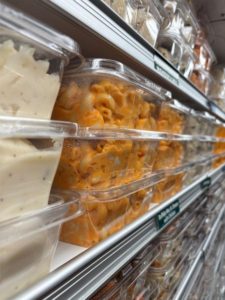 Fixed weight means every package is supposed to hit the same declared weight — think “16 oz for $5.99.” Simple, predictable, easy to put on a shelf sign.
Variable weight means the consumer pays for exactly what’s in the package, weighed and priced individually based on that weight. The sign shows the price per lb, but each individual package has its own slightly different price, depending on its actual weight. That’s your fresh meat counter, your deli case, or those bags of grapes with a scale-printed sticker.
Neither one is “better.” They’re just built for different jobs. The trouble starts when a business picks one out of habit instead of fit.
Which One Actually Saves More Money?
It’s time to look at what we’re all thinking about here: Your bottom line.
Here’s the part nobody loves to admit: Fixed-weight programs can create product giveaway through overfill. Because producers must ensure packages meet the declared net weight requirements, some operations intentionally target slightly above the stated weight. Even small amounts of overfill can add up at high volumes.
Variable weight sidesteps that problem, since you’re pricing what’s actually in the container. But it isn’t free money either (there’s always a catch). Scales, labeling systems, and point-of-sale upgrades all cost something. The real question isn’t which option is cheaper on paper. It’s which one is most cost-efficient for your product and your operation.
Does the Packaging Choice Affect Shipping and Warehouse Costs?
 Generally, yes.
 Variable weight can still ship efficiently, but it needs systems that track both package count and total weight, not just one or the other. It’s not a dealbreaker, just a different kind of bookkeeping.
What Kinds of Food Actually Belong in Each Category?
Fixed weight works especially well for standardized, easily portioned foods where each package is intended to contain a consistent quantity, such as yogurt, snack foods, frozen meals, cereal, fresh-cut fruit, hummus, and dips.
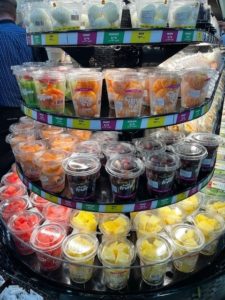
Variable weight earns its keep with anything that refuses to be uniform: Fresh meat, seafood, cheese, fresh-cut fruit and veggies, deli items, bakery goods. Nature didn’t design a pineapple to weigh the same every time, and pricing by weight lets you sell what’s actually there instead of forcing every piece into an identical box.
How Do Consumers Actually Feel About This?

Here’s the human side of the equation: Certainty sells.
With fixed weight, what you see is what you pay. A $5.99 tag means $5.99 at checkout — no surprises. See the image above, for example.
Variable weight can’t make that same promise, and when it’s not labeled clearly, it leads to something retailers call “sticker shock.” A shopper grabs a $3.77 tray of pineapple, gets to the register, and suddenly it’s $12.27 because the price was actually per pound. Cue the confused look — and the store associate explaining, again, why fruit isn’t priced like a candy bar. You know what that means? Many consumers may then simply leave the package of food at the register. (You know where we’re going with this.) Left-out food leads to temperature variations, possible spoilage, and ultimately wasted product.
Some retailers have had to slap extra signs on shelves just to spell out “per pound” in plain English.
There’s also a gut-level bias at play: Given a $12 fixed-weight bag next to a $16 variable-weight one — even if the $16 bag has more fruit in it — most shoppers will grab the $12 bag. It feels safer, even when it isn’t the better deal.
None of this makes variable weight a bad choice. Shoppers already expect it at the meat counter. But in produce, where it’s less familiar, clear labeling isn’t a nice-to-have — it’s the difference between “per pound” and a consumer complaint.
How Do I Figure Out Which One Is Right for My Business?
 Ask yourself a few honest questions:
- Can this product be portioned consistently? Uniform products lean toward fixed weight. Naturally variable products lean toward variable weight.
- How much labor does it take to hit an exact target weight? If your team is constantly adding and pulling product to nail a number, that labor cost is eating your fixed-weight savings.
- How much are you actually overfilling? Some businesses have never measured this. It’s worth doing before it becomes a permanent leak (see what we did there?) in the budget.
- What do your consumers expect? Shoppers grabbing a snack want a flat price. Shoppers at the meat counter expect price-per-pound. Category matters.
- How important is promotional simplicity? “Two for $10” only works cleanly when every package is identical.
There’s rarely a universally right answer; just a right answer for your product, your labor, and your buyers.
Does the Answer Change for Retailers and Processors?
Kind of…but let’s break it down: A retailer packing in-store and a processor cranking out a large number of packages a day are staring at the same two choices, but weighing different things.
Processors think in scale: Automation, filling accuracy, consistent cases, and hitting a retail customer’s exact specs. Giveaway adds up fast at that volume, which is usually why processors lean toward fixed weight.
Retailers packing at the store level care more about associate labor, simple equipment, and how the product looks in the case right now. When yield and labor are the real pain points, variable weight may win out in that instance.
Neither side is wrong…it depends on which end of the supply chain you’re standing at.
It’s Time to Weigh In
Whichever model you run, the container does a lot of the heavy lifting. For fixed weight, the right size means the product fits naturally, so no one has to overfill just to make it look good.
For variable weight, the right shape keeps the shelf looking consistent even when the pounds don’t match from one package to another. And whether you’re a processor chasing consistency at scale or a retailer juggling labor and yield at the store level, the right container makes the job easier either way.
Inline builds in clear visibility, tamper evidence, and sturdy protection so the product looks and stays at its best. Five decades in, and we’re still finding the right container for the job. Let’s talk.
Are you interested in finding out more about packaging solutions for fresh food? Visit our Learning Center today and explore a wide variety of topics.

