At a Glance
- Food safety failures often come from small sanitation gaps, not lack of effort, and one pathogen event can undo years of trust and investment.
- Using sanitation zones helps facilities prioritize risk, focusing the most rigorous cleaning where food contact actually occurs.
- Dry cleaning strategies reduce pathogen spread by limiting moisture, which can otherwise reactivate and transport bacteria through a facility.
- Effective food safety depends on verification and culture — measurable testing, clear procedures, and teams that understand they’re protecting both public health and the business.
You’ve invested everything into your food business. Your recipes are perfect, your team is trained, and your equipment is top-notch. Then one day, a routine test comes back positive for Listeria — a dangerous bacterium that can cause serious illness and even death — and suddenly everything you’ve built is at risk.
This is the worst-case scenario. But how did you end up here? Could you have prevented this from happening?
Here’s the uncomfortable truth: Pathogens (really harmful microorganisms like bacteria and viruses that cause foodborne illnesses) don’t care about your investment. They’re looking for any opening, any moisture, or any surface where they can establish a foothold. One outbreak can destroy a reputation you spent years building.
So what’s a food business owner supposed to do? We sat down with Dr. Richard Walsh, Senior Staff Scientist in the Food & Beverage Division at Ecolab, to find out. Ecolab is a global leader in water treatment, hygiene, and infection prevention — the company provides science-based solutions that help businesses maintain clean and safe operations while achieving sustainability goals.
But here’s the good news: You don’t have to choose between safety and efficiency. Modern sanitation strategies that actually work exist, and you can get ahead of it before the whole pathogen-nightmare raises its ugly head. Even better, implementing measures to minimize risks for pathogen transmission works equally for non-public-health-related organisms, in particular yeasts and molds. In working to keep your product safe, you will also be maximizing the shelf life of the food and ensuring it is the best quality it can be.
This article breaks down practical approaches to food safety, from understanding sanitation zones to implementing dry cleaning protocols that reduce risk without grinding production to a halt.
What Are Sanitation Zones and Why Should You Care?
Think of sanitation zones as your defense strategy against contamination. Instead of treating your entire facility the same way, zones help you “divide and conquer” by focusing attention where it matters most.
Zone 1 is where food directly contacts surfaces — your production line, filling equipment, anything that touches what consumers will eat. This is your red alert area. The zones go outward from there. Zone 2 is where indirect contact may occur — think machine control panels. Zone 3 is considered to be in “close proximity” — examples could be storage areas and catwalks. And finally, Zone 4 might be a hallway or office space far from production. Less critical, but still important.
The brilliant part? This isn’t about forcing you to tackle everything at once. By identifying zones, you can prioritize your testing, cleaning intensity, and response protocols based on actual risk levels.
How Does Dry Cleaning Protect Your Products?
 Here’s where things get interesting. When most people hear “cleaning,” they picture water, hoses, and lots of soap. But in many food plants, that traditional approach actually creates more problems than it solves.
Water can reactivate dormant pathogens, providing them with a highway to travel throughout your facility. Think of water like an alarm clock for bacteria (well, an alarm clock that wakes germs up and transports them to other areas). One dry food manufacturer learned this the hard way when Salmonella showed up in its product twice — seven years apart, with the same strain. The investigation revealed that water-based cleaning was spreading the problem instead of solving it.
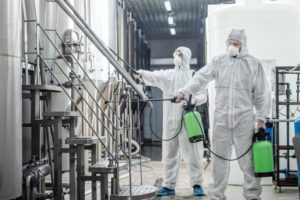
Dry cleaning doesn’t mean zero water. (No, it’s not like taking your dress pants to the cleaner.) It means controlled, strategic use of moisture. You’re containing water exactly where it needs to be, using it systematically, and preventing it from becoming a “contamination vector” — basically a transport system that carries contamination from one place to another.
Here’s a high-level tutorial of the dry-cleaning process: First, remove gross soils mechanically with brushes while carefully disassembling the equipment. Then use minimal moisture with spray bottles to clean residual soils. Finally, apply sanitizer that dries on its own — killing microbes without leaving standing water behind.
Compare this to grabbing a hose and spraying everything down. That might feel productive, but you could be blasting contained problems all over your facility. Even air hoses can be dangerous, turning a localized issue into an airborne disaster. It’s like using a leaf blower in a room full of glitter — impressive, but you’ll regret it.
Why Do Sanitation Procedures Take So Long?
Let’s answer this question right off the top: These procedures take time because they need to be done thoroughly and properly. If someone on your cleaning crew is finishing in half the expected time, that’s not efficiency. It’s a red flag.
Effective sanitation has benchmarks for a reason. Just like an auto shop knows how long a brake job should take, your facility needs to know how long proper equipment cleaning requires. When you establish these metrics, you gain control. You can plan staffing, calculate turnaround times, and spot problems before they become issues.
The goal isn’t speed. It’s consistency and effectiveness.
How Do You Know If Your Cleaning Actually Works?
“It looks clean” isn’t a food-safety strategy. It’s not even a “let’s straighten up the living room” strategy. Visual inspection is just your starting point.
The most practical verification tool? Swabs. They’ve become so mainstream that celebrity chef Gordon Ramsay uses them on reality TV shows to test for sanitation. The technology has standardized, costs have dropped, and they give you actual numbers to measure success against.
Yes, there’s an upfront investment. But consider the alternative: Betting your entire business on visual inspection and hoping for the best? Losing your business is infinitely more expensive than a swab test.
For smaller operations worried about cost, start simple. A detailed cleaning plan costs nothing but time — just a document outlining procedures and checkpoints. That alone puts you miles ahead of facilities operating on “we think it looks good.”
Following cleaning, the application of surface sanitizers or disinfectants assures microbial control for your establishment. The system in place starts with the product label: Read the label for its claims, and know that this is a critical piece of your food-safety plan, because the label is the validation. The Environmental Protection Agency (EPA) allows manufacturers to make label claims only after the product has been tested and the data is shared with and reviewed by the EPA. Once the EPA grants the claims, you do not have to validate the product’s performance, you just have to use it according to the label instructions.
What Role Does Company Culture Play in Food Safety?
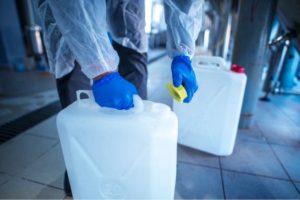 When your cleaning team doesn’t understand why their work matters, they may not feel the need to be as thorough, and nobody can blame them — it’s tough work. They’re gowned up in rain suits and goggles, working in hot, steamy conditions with industrial-grade chemicals, like something out of a science-fiction movie.
So what’s the mission?
First: Safety for your team. All that protective gear exists so they go home healthy. Make sure the cleaning team understands the need for and properly wears the required personal protective equipment as prescribed for each cleaning product.
Second: Safety for consumers. Your cleaning crew is literally the last line of defense between a pathogen and someone’s dinner table. When people get sick from food, they remember. Forever. Or when they have to throw out half the product because it spoiled before they can consume it, they are less likely to be a repeat customer.
When your team understands this mission, everything changes. They’re not just mopping floors — they’re protecting public health and your business reputation. That context transforms compliance from a checklist into a purpose.
A Clean Start
Food safety doesn’t have a finish line. As nature has proven time and again (thanks, Jeff Goldblum in Jurassic Park), “life finds a way” — and that can be a bad thing. Your job is to stay one step ahead — with smart zone management, effective dry-cleaning protocols, measurable verification methods, and a team that understands the stakes.
Start with what you can control today. Document your current procedures. Establish baselines. Build a culture where sanitation isn’t punishment — it’s protection — and, above all else, make sure your team knows how vital their work is to the food industry.
Because at the end of the day, your food-safety program isn’t just about compliance. It’s about making sure every product leaving your facility is safe, your team goes home healthy, and your business keeps running.
That’s worth the investment.
Do you want to know more about packaging and the fresh food industry? Visit our Learning Center today and explore a variety of topics.
Do you want to learn more about food safety? Visit Ecolab’s website today, or connect with them on LinkedIn.