Listen to the audio recording of this blog post or check out the featured Podcast about this topic.
At a Glance
- PET is more durable and supply-chain ready — it flexes before breaking, while OPS is rigid and more prone to cracking, especially under pressure or cold conditions.
- Temperature performance favors PET — OPS struggles in cold and heat, while PET (and especially CPET) handles a wider range, even freezer-to-oven in some cases.
- Shelf life is a major separator — PET has strong oxygen and moisture barriers, helping food stay fresh longer; OPS is best for short shelf-life items like bakery or sushi trays.
- Recyclability is where PET clearly wins — PET is widely collected and reused (rPET market exists), while OPS is rarely recycled in practice due to lack of infrastructure and demand.
Let’s get right to it: Packaging performance isn’t a footnote. It’s what stands between your product and a bad customer experience. A cracked lid, a soggy bottom, a clamshell that didn’t survive the truck ride — none of that is forgiven just because the food inside was incredible enough to impress Julia Child. But you already knew this, didn’t you?
That’s why it’s important to talk about material options, especially in the realm of plastics. Among the options for food packaging, many food businesses use PET (Polyethylene Terephthalate — let’s see if Julia Child can pronounce that!). Yet, there is another material that many companies use, and you may not realize its presence: OPS (Oriented Polystyrene). But what are the actual differences and similarities, aside from both being impossible to pronounce?
Getting Answers
To get clarity on this material matter, we sat down with expert Conor Carlin. Carlin is the Founder and President of Clefs Advisory, LLC, and served as the Society of Plastics Engineers‘ President in 2024. His background includes a tenure as North American General Manager of ILLIG, and his expertise spans materials science, advanced recycling technologies, environmental policy, and commercial strategy — all built through extensive experience at the intersection of packaging innovation and sustainability.
This article covers how OPS and PET stack up on the things that actually matter in the real world: Durability, temperature handling, barrier properties, heat performance, and yes, what happens when your customer tosses it in the recycling bin (and hopefully not the trash!).
Which Packaging is More Durable: OPS or PET?
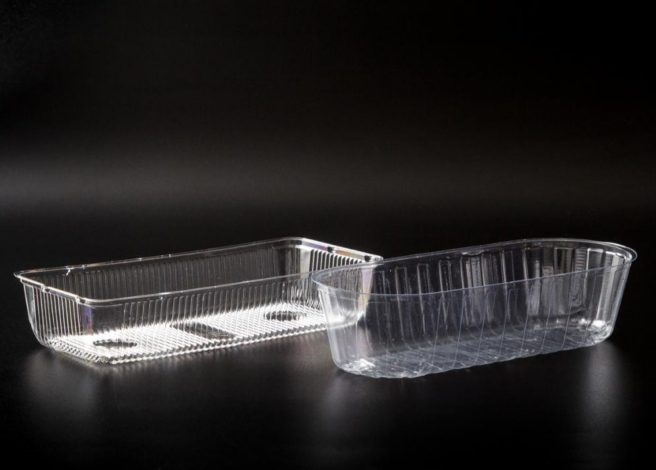
 OPS is a lightweight, rigid material — and that rigidity is by design. If you’ve ever handled a cake dome or sushi tray lid and noticed that characteristic thin, crisp snap, you’ve experienced OPS in its intended form. It’s also recognizable in cookie trays and as lids paired with aluminum bases, where that light, resonant quality is practically a signature trait. That “tinny” sound is kind of its catchphrase — the “D’oh!” of the packaging world (with all respect to Homer Simpson).
OPS is an amorphous material, meaning its molecular structure is relatively disordered. This makes it well-suited for applications that prioritize clarity and lightweight presentation, though it does make it more susceptible to stress fractures under pressure or impact. In cold environments, polystyrene becomes stiffer, which is worth considering for refrigerated applications.
PET handles both scenarios without drama. PET can actually be called “APET” or “CPET” depending on how it is processed. The “A” is for amorphous. The “C” is for crystalline. Most of what we see in clear food packaging, including bottles, is APET. The more complex molecular structure that includes semi-crystalline regions is where CPET thrives, with greater heat resistance and structural integrity, but less clarity. It bends a little before it breaks. For anything moving through a real supply chain — palletized, refrigerated, stacked, shipped — PET is built for the job.
How Do OPS and PET Handle Temperature?
Cold environments can be a challenge for OPS, as lower temperatures increase stiffness and the potential for cracking — something to weigh carefully if your product lives in a 34°F deli case or gets shipped on a refrigerated truck. That said, for ambient or mildly chilled applications, OPS performs reliably within its intended range.
Heat is a different story — and a more nuanced one. OPS actually has a lower heat tolerance than you might expect. When polystyrene plastic sheets are made, they get stretched and pulled during the manufacturing process. This stretching creates built-up tension inside the material — almost like a stretched rubber band frozen in place. When the sheets are heated again later to mold them into shapes, that tension releases and the plastic shrinks. This caused a lot of problems in early factories. The good news is that manufacturing improved over the years and made the shrinking less severe, but OPS is still more sensitive to heat than most other plastics used in packaging.
PET handles a wider temperature range with more stability. CPET (crystallized PET — the cousin of traditional PET) can even go from freezer to oven — a feat OPS could never pull off (though we’d love to see it try!).
Does Packaging Affect Shelf Life?
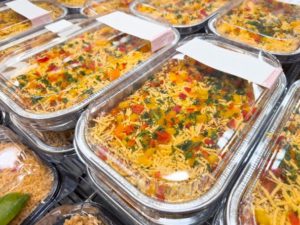 This is where PET pulls away in a category that OPS can’t compete in: Barrier performance. PET naturally resists oxygen and water vapor transmission — what packaging engineers call OTR (oxygen transmission rate) and WVTR (water vapor transmission rate). In plain terms, PET keeps outside air out and inside moisture in, which means fresher product for longer without the need for special coatings or additives.
OPS has more modest barrier properties — but that’s a reflection of what it was designed to do. Sushi trays, bakery domes, and cookie trays don’t require high barrier performance because they’re sold and consumed quickly. For those applications, OPS’s clarity and cost-efficiency are exactly what’s needed. But for fresh-cut produce, deli proteins, or anything with a multi-day shelf life, a higher-barrier material is the right choice.
If your product needs to look and taste great on day five, PET is doing work that OPS simply can’t.
Is OPS Packaging Recyclable?
Technically, yes. Practically, almost never — and that distinction matters.
When your packaging hits the recycling bin, it ends up at a Material Recovery Facility (MRF), where it undergoes high-speed sorting using wind sifters, optical scanners, and near-infrared (NIR) technology. Those NIR scanners are calibrated to find the materials with real market value — primarily PET (RIC #1) and HDPE (RIC #2). Polystyrene (RIC #6) doesn’t have a reliable sorting path at most facilities. If it doesn’t read as something valuable, it ends up in a mixed pile or the landfill.
Do you want to learn more about RIC codes and how they affect sorting? Click here.
It’s not a technology problem. Polystyrene can be recycled. Some large styrene producers have even run take-back programs. The problem is economics: There’s no meaningful market for recycled polystyrene. No demand, no value, no incentive for MRFs to sort it. Without that demand signal, the infrastructure never develops.
OPS packaging almost always ends up as waste. That’s a sad one-way trip.
Does PET Actually Get Recycled?
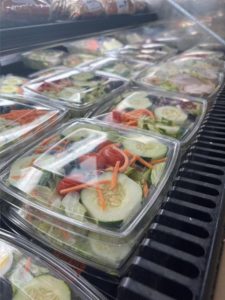 Yes — and meaningfully so. PET is one of the few plastics that the recycling system actively wants. NIR scanners at MRFs are specifically calibrated to identify, divert, and bale it for resale. That bale gets processed into flake, then pellet, then new material.
RPET (recycled PET) is a real, commercially viable product with an active market. Brands and regions are increasingly setting rPET content targets — 15%, 30%, 50%, or even higher — for post-consumer recycled content because retail buyers and regulators are pushing for it. Under Extended Producer Responsibility (EPR) programs expanding across North America, PET is well-positioned, with proven end markets. OPS is not.
If sustainability is part of your brand’s story, PET gives you a concrete way to say it. OPS leaves you with a shrug.
So Which Should a Material Girl (or Guy) Choose?
OPS has a legitimate and well-established use case: Quick-turn, locally sold items like cookie trays, bakery domes, and takeout lids that don’t travel far, don’t need barrier protection, and don’t require heavy-duty durability. In those settings, OPS delivers real value — it’s optically clear, lightweight, cost-effective, and fit for purpose. For the right application, it’s a sensible choice.
But for most food businesses managing real supply chains, refrigerated products, multi-day shelf life, or any brand commitment to sustainability, PET wins on nearly every measure that matters. It’s tougher, has better barrier performance, and actually makes it back through the recycling system.
The OPS-to-PET switch feels bigger than it is. For most applications, it’s a straightforward upgrade — one your supply chain, your customers, and your sustainability report will all quietly thank you for.
Do you want to learn more about packaging materials? Visit our Learning Center today and explore a variety of topics.
Would you like to know more about Conor Carlin and his work at Clefs Advisory LLC? Connect with him on LinkedIn today.