At a Glance
- Smart packaging trends are redefining 2026, led by smart labels that monitor temperature, time, and humidity to ensure food safety and transparency throughout the cold chain.
- Sustainability is getting practical — pulp and paper materials are emerging as leaders thanks to recyclability and lightweight design, though barrier layers still pose challenges.
- Testing is non-negotiable: Skipping it can lead to costly production failures and recalls, emphasizing the value of early, thorough validation.
- The future of packaging lies in combining automation, sustainable materials, and data-driven smart technology to build consumer trust and operational efficiency.
The packaging world is moving faster than free samples at a warehouse club store. Smart labels are gaining momentum, sustainable materials are getting sustainable (finally), and customers want to know everything from farm origins to whether their frozen pizza actually stayed frozen.
Remember when the biggest packaging decision was paper or plastic? Simpler times. Now you’re juggling sustainability, food safety, consumer expectations, and a budget that somehow needs to cover all three.
We get how stressful all of these pressures can be. At Inline Plastics, we’ve been working to innovate packaging for the past 55 years, and we’re not stopping now.
This week, we sat down with Renee Benson, a Process Engineer with CRB. As an engineering, architecture, construction, and consulting firm, CRB designs and builds the facilities, complex systems, and workflows that packaging and processing innovations depend on. From smart labels to advanced automation and next-generation materials, CRB works where emerging packaging and processing technologies are implemented — giving the team a uniquely credible perspective on which trends are shaping the future.
This article covers the packaging innovations shaping 2026, what they’ll cost you, and how to avoid catastrophically expensive mistakes.
- Smart labels that monitor temperature, time, and handling throughout the cold chain.
- Sustainable materials (especially pulp and paper) that work with existing recycling systems.
- Better barrier technology that balances shelf life with recyclability.
- Data-driven automation that improves food safety and reduces labor strain.
- More rigorous packaging testing to prevent expensive failures during production or at market.
What Sustainable Packaging Actually Works?
 Let’s get uncomfortable: Most bio-based plastics perform like conventional plastics — they don’t break down faster unless specifically engineered to do so, and often need the proper recycling infrastructure in place. Marketing departments love them. Landfills? Not so much.
The real sustainability winners of 2026 are pulp and paper materials. They’re lightweight, they maintain structural integrity, and — here’s the kicker — they can actually get recycled in most municipal systems.
But (there’s always a but) once you add barrier layers for shelf life, you’ve basically created a recycling nightmare. Those plastic films adhered to paper? Most U.S. facilities can’t separate them.
And the infrastructure problems get weirder. One D.C.-area municipality stopped accepting glass and metal — the infinitely recyclable materials — but still takes PET and HDPE bottles. Why? Contract limitations. So much for doing the right thing. Let’s not get discouraged, though!
To view a sustainable package as “successfully doing its job and delivering on promises,” companies must first consider consumer perceptions. Let’s take a deeper look at one such instance.
Why Did Customers Hate That Biodegradable Chip Bag?
 A major snack brand launched biodegradable bags for its chips. The material worked perfectly. It protected the product. Sales tanked anyway.
The problem? The bag didn’t sound right when customers grabbed it. That’s it. The wrong crinkle sound killed the product.
This sounds ridiculous until you remember humans use all five senses when buying food. We’re not rational creatures calmly analyzing packaging materials. We’re grabbing snacks after work, and if something feels off, we’re moving to the next shelf.
The fix isn’t abandoning sustainable materials in 2026. It’s getting ahead of the weird stuff and positioning products better. The bag had “This bag is louder because it is compostable” printed on it. Had this bag been marketed differently, say, with a slogan like “A Difference You Can Hear,” perhaps it could have been more successful.
Consider marketing your quieter bag as “library-friendly” or “movie theater approved.” Make the change part of your story instead of crossing your fingers and hoping nobody notices. They will notice. They always do.
What’s the Real Cost of Skipping Testing?
Before we continue with packaging innovation for 2026, it’s important to emphasize the need for proper testing. Our expert shared an anecdote about a company that redesigned its shampoo bottles to save money and speed up the launch — new shape, new formula, straight to production. After spending hundreds of thousands on molds and manufacturing, someone finally tested it. The bottles didn’t dispense properly. Customers hated them. The company scrapped everything.
Another brand changed its package graphics — seems harmless, right? But the new metalized inks absorbed heat differently than standard inks. That meant the shrink film didn’t tighten correctly on the line — a small change that triggered six-figure recalibration costs across 20 plants.
Here’s the pattern: Skipping testing to save money ends up costing way more money. Test on every piece of equipment. Test at co-packers. Early failures are cheap. Market failures are “explaining to the CEO why we’re pulling the product” expensive.
What Are Smart Labels and How Do They Actually Work?
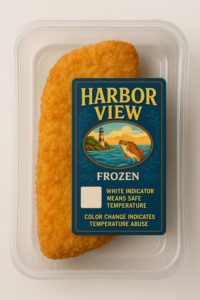
Image created using AI.
Getting back to the matter at hand, smart labels aren’t futuristic anymore — they’re pressure-sensitive stickers with built-in sensors that track temperature, time, humidity, or other conditions that matter to your product.
A label gets applied during normal manufacturing. The technology inside (chemical, enzymatic, or nanoparticle-based) reacts to specific triggers. Too warm? It changes color. Sitting too long? The indicator shows it. Simple.
For frozen or refrigerated products, customers see whether the food stayed at safe temperatures from your facility through retail. A white indicator means you’re good. Color changes mean someone messed up in that cold chain.
Get ready for the best part: These aren’t expensive and require no special equipment. That means no holes in your packaging. Just labels you apply like any other label.
What Else Can Smart Labels Monitor Besides Temperature?
Temperature tracking is just the start. QR codes can show complete farm-to-table traceability. Customers scan a code and see which farms provided the wheat, eggs, and sugar in their bread. Some even offer recipes!
This isn’t just feel-good marketing. The FDA’s Food Safety Modernization Act (FSMA) includes track-and-trace requirements, outlined in regulation Section 204 (coming in January 2026), which establishes traceability mandates for certain higher-risk foods in the U.S. supply chain. Smart QR codes handle compliance while making your marketing team happy. Win-win.
What’s the Biggest Packaging Trend for the Next Five Years?
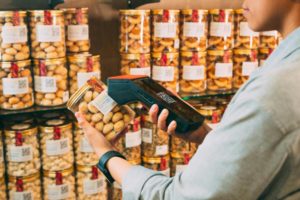
Packaging made with sustainable materials and smart labels focused on food safety will dominate through 2026 and beyond.
Customers want proof that their food is safe, especially with regular recalls making headlines. If a recall happens, brands need to know where in the supply chain the problem occurred. Smart labels tracking temperature and handling provide that proof. No trust required — they can see it themselves.
The technology keeps working after purchase, too. That indicator shows whether frozen dinners thawed during a power outage or if leaving groceries in a hot car was a terrible idea (it was). Food safety extends from manufacturing through consumption, and smart labels cover that whole journey.
What Would Actually Improve Food Packaging in 2026?
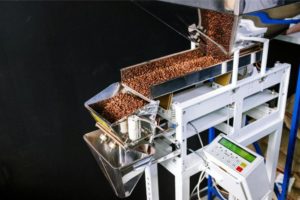 More automation would solve multiple problems at once. Automated systems reduce repetitive-motion injuries, improve consistency, and generate data that enhances food safety.
Real automation isn’t just robots on lines — it’s also about smart technology that tracks products from the factory floor all the way to the pallet. If a line suddenly stops, the system (if engineered properly — shout out to CRB) should automatically send the products to cold storage or alert the team to check for quality issues.
Humans are essential for problem-solving and decision-making. Robots excel at repetitive physical tasks. Let each do what we’re good at, and everyone benefits.
Getting Smart About What’s Next
 Packaging innovation in 2026 focuses on three things: Sustainability that works with existing infrastructure, smart labels that provide transparency and food-safety proof, and thorough testing before launch.
Successful brands will communicate changes clearly, understand inherent trade-offs in every decision, and invest in testing before rolling out across facilities.
Smart labels aren’t coming — they’re here. Your customers are ready for proof instead of promises. The question is whether your brand will lead or spend 2026 playing catch-up.
The chips that didn’t crinkle right should have taught us something: Customers notice everything. Give them something worth noticing.
Are you interested in learning more about plastic food packaging trends? Visit our Learning Center today and explore a wide range of topics.
Do you want to learn more about CRB? Visit their website now and use their “Contact Us” feature.