
At a Glance
- California’s AB-3336 requires ready-to-eat food delivered through third-party services to be sealed with a tamper-evident method before leaving the restaurant.
- The goal is to protect consumers and give customers confidence that their food hasn’t been opened or altered during delivery.
- Common solutions include tamper-evident stickers, sealed bags, and containers with built-in tamper protection.
- Beyond compliance, tamper-evident packaging helps protect brand reputation and build customer trust.
DISCLAIMER: This document is designed as an introduction to California’s Assembly Bill 3336 and contains summary information. The information provided in this document does not constitute legal advice and is not a substitute for the advice of an attorney. All liability with respect to actions taken or not taken based on the contents of this document is expressly disclaimed.
Here is something that will come as a shock to literally no one: Food delivery has exploded over the last decade. COVID pushed it into hyperdrive. Today, a customer can order dinner from a restaurant they’ve never visited, delivered by a driver they’ve never met, and expect it to arrive exactly the way it left the kitchen. That’s a tall order (clever wording, right?) — and California noticed.
Enter Assembly Bill 3336. California enacted AB-3336 in September 2020, and the law took effect on January 1, 2021, setting a new standard for how ready-to-eat food must be packaged and handled when it moves through third-party delivery platforms like DoorDash, Uber Eats, and Grubhub. If you’re a food business operating in California, this law applies to you.
How Are You Supposed to Understand and Comply with This Regulation?
Inline Plastics has been providing packaging solutions to fresh food businesses for over 55 years. While we do not claim to be legal experts, we have seen the impact of regulations on operations and know the toll they can take on a business just trying to understand what is right and wrong (beyond mixing caramel and fish…unless that’s your specialty).
In this article, we’ll break down what AB-3336 actually says, who it affects, how it’s enforced, and what it means for the way you package food going out the door.
Your Customers Already Expect This
 Before we get into the law itself, here’s something worth sitting with: A significant number of delivery drivers report having tampered with someone else’s food order. Whether that number feels high or low, the message is clear. People receiving delivery orders are paying attention to whether their food has been sealed — and they’re making decisions about whether to use a service again based on what they find.
Customer trust is hard to earn and easy to lose. When a delivery arrives with an obviously resealed bag or a lid that doesn’t quite sit right, the damage isn’t just to that one order. It’s to the restaurant’s reputation, the platform’s reliability, and ultimately, the entire experience that made delivery worth ordering in the first place. AB-3336 didn’t create this problem. It just put it in writing.
So, What Does AB-3336 Actually Say?
 It’s time to put on our legal hats, or, if you’re in the UK, our legal wigs.
The law adds Section 113930.5 to California’s Health and Safety Code and amends Section 113982. In plain language, here’s what it requires:
All bags or containers holding ready-to-eat food must be sealed with a tamper-evident (or tamper-obvious) method before the delivery driver takes possession of the food.
The food facility — meaning the restaurant or food business — is responsible for doing the sealing. The driver is responsible for not taking food that hasn’t been properly sealed (in states or jurisdictions where such a law exists). And the third-party platform sits in an interesting middle position, which we’ll get to in a moment.
The law also requires that food be transported in a clean holding area, maintained at the proper temperature, and protected from contamination — standards that largely existed before but now apply specifically to third-party delivery scenarios.
A few things are exempt: Prepackaged, non-potentially hazardous foods don’t fall under this rule, and neither does food transported as part of a charitable feeding program or donated to a food bank.
What Does “Tamper-Evident” Actually Mean?
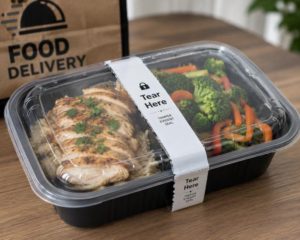 This is where it gets “interesting” (and perhaps a bit “persnickety”) — because the law doesn’t hand you a checklist. It doesn’t say “use this exact sticker” or “buy this specific container.” What it does say is that the seal must provide visible evidence if it has been broken, torn, or ripped, and must be designed so it cannot be readily duplicated or restored once compromised.
That second part matters more than people realize. A generic, colored dot sticker you can buy in bulk at any office supply store? Probably not going to cut it — anyone could buy the same ones (we need to emphasize that we’re not trying to vilify delivery drivers here). A branded sticker with a restaurant’s logo, or a custom seal specific to the platform? That’s more in line with what the law intends.
Common approaches that tend to work well include:
- Branded or custom tamper-evident stickers that show visible tearing if removed
- Stapled bags — though only when the staple holes themselves provide visible evidence of tampering, and as long as a driver can’t just re-staple
- Containers with built-in tamper-evident features (locking tabs, perforated seals)
The key question to ask yourself: If a customer receives this order, can they tell at a glance whether someone opened it? If the answer is yes, you’re on the right track.
Who’s Actually on the Hook?
 Like your award-winning tiramisu, things are about to get layered.
The onus of this law falls on three parties:
- The restaurant is responsible for sealing the food.
- The driver is expected to refuse food that hasn’t been sealed.
- Enforcement officers can recover costs directly from the third-party platform when their drivers don’t comply.
In practice, fines tend to fall on the third-party app, not the restaurant — though the restaurant isn’t entirely off the hook if it refuses to seal orders. Drivers themselves can face individual penalties, including criminal misdemeanor charges where applicable.
It’s also worth noting the cross-state wrinkle for nuance: Restaurant compliance is governed by the origin state. But the destination state governs driver and platform compliance. If you’re delivering into California from a state without similar laws, California’s rules still apply at the point of delivery.
Enforcement is handled primarily by local and state health authorities — think health inspectors, not police. It is unlikely that a state trooper will pull over a driver and arrest them for smelling fries on their breath.
Is Anyone Actually Enforcing This?
Honestly? Let’s be real.
Formal enforcement cases are hard to find. But that doesn’t mean the law is pointless — it means the market is doing some of the enforcing itself.
Restaurants and platforms that adopted tamper-evident packaging have seen the payoff in customer loyalty. Those that haven’t are quietly losing repeat business to competitors who make customers feel safer. It’s self-regulation through the power of the review, the reorder, and the “nope, never again.”
That said, the grace period is over. The law is on the books. Health inspectors are aware of it. And as delivery volumes continue to grow, it’s reasonable to expect enforcement to become more visible over time.
What This Means for Your Business
 If you’re a food business sending orders out through any third-party delivery platform, AB-3336 isn’t just a California compliance checkbox — it’s a framework for thinking about how your food arrives in your customer’s hands.
The good news is that tamper-evident packaging doesn’t have to be complicated or expensive. Many purpose-built containers already include tamper-evident features, which can actually be more cost-effective than buying rolls of branded stickers separately. Your packaging distributor or supplier is a solid starting point for finding options that work for your specific menu.
The law also opens the door to a useful conversation with your local health department. They’re your enforcement liaison and, usually, a helpful resource for understanding what’s expected before an inspection, not after.
The Answers Are Evident
AB-3336 ultimately asks food businesses to do something that was already good practice: Make sure the food you’re proud of actually gets to your customer in the condition you intended.
California isn’t asking businesses to overhaul their operations completely. These easy-to-follow guidelines let your customers know that their food is safe from the kitchen to the destination. It’s just about showing proof. “Signed, sealed, delivered” (Thank you, Stevie Wonder).
Are you interested in learning more about tamper-evident packaging? Visit the Inline Plastics Learning Center today!
DISCLAIMER: This document is designed as an introduction to California’s Assembly Bill 3336 and contains summary information. The information provided in this document does not constitute legal advice and is not a substitute for the advice of an attorney. All liability with respect to actions taken or not taken based on the contents of this document is expressly disclaimed.