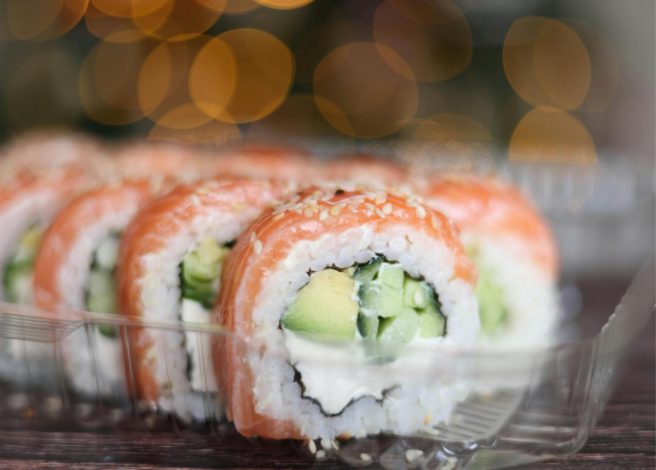
At a Glance
- OPS may look cheaper on paper, but breakage, spoilage, and shelf-life limitations can offset its cost advantage.
- PET is more durable, offers better food protection, and helps reduce waste.
- New EPR regulations could make OPS more expensive due to low recycling value and potential fees.
- PET has stronger recycling infrastructure, PCR content availability, and long-term market support.
You probably have it in your home but may not realize it. That’s okay. Let’s rip the bandage off: We’re talking about Oriented Polystyrene (OPS). You’ll find it in trays for packaged cookies and as the clear plastic lids on many aluminum takeout containers.
This material has infiltrated many operations and many of our own pantries and refrigerators over the years, and that’s nothing new. OPS has dominated the plastic food packaging industry and previously set an industry standard for safe and trusted preservation solutions for decades.
That is, until PET (Polyethylene Terephthalate) entered the picture, challenging it at every level: We’re talking cost, performance, presentation, durability…the list goes on. When a new contender enters the ring, it can be intimidating to anyone, especially those unwilling to adapt to industry changes.
As a food business professional, you face challenges every day. You may have received advice to switch from your current packaging material, OPS, to PET. It’s not challenging, right? (Just kidding.) It’s not like you have to rethink your entire packaging portfolio, presentation profile, sustainability targets, and ultimately…(let’s get right to the point) cost.
The question at hand is: What makes more sense financially: Sticking with OPS or converting to PET?
At Inline Plastics, we’ve produced OPS and switched to PET, but for deeper insight into how costs work for these materials, we turned to industry expert Conor Carlin, founder of Clefs Advisory, LLC. Conor recently served as the 2024 President of the Society of Plastics Engineers and previously led ILLIG’s North American operations, bringing extensive expertise in packaging, sustainability, and materials markets.
In this article, we’ll break down the real price comparison between PET and OPS, what buyers may miss when they run the numbers, and why the regulatory landscape is about to change the math entirely.
The Price Tag Is Lying to You
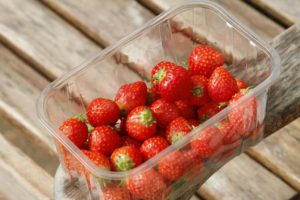 There. We said it.
Let’s start with the number everyone looks at first: The price per pound. On the surface, OPS has historically appeared competitive (sometimes cheaper) when compared to PET. That’s the hook. That’s why it’s still in the conversation at all. But price per pound is not the whole story.
Time to Get Math-y
OPS has a lower density than PET. Its specific gravity sits around 1.05, compared to PET’s 1.33. What that means in plain English: You get more parts out of a pound of OPS than a pound of PET — roughly 27.5% more yield. So if someone’s quoting you both materials at similar prices per pound, OPS looks like the obvious winner. You’re getting more product for your dollar, right?
Sure. Until you look at everything else (you knew a turn was coming).
What the Yield Doesn’t Tell You
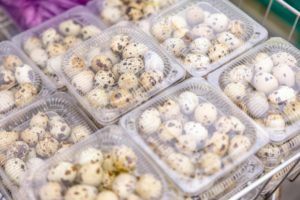 OPS is more brittle than PET, making it more prone to cracking and damage. In foodservice, a cracked lid or broken clamshell can lead to customer complaints, returns, lost sales, and added cleanup costs.
Breakage is often overlooked when comparing materials, but those costs are real and can add up over time.
Shelf life is another consideration. OPS has a higher oxygen transmission rate (OTR) than PET, allowing more oxygen to reach the product. For bakery, deli, and prepared foods, that can mean a shorter selling window and more spoilage — reducing the value of any yield advantage.
That so-called “yield advantage” starts looking a lot less impressive when you factor in the spoilage of what used to be muffins but now looks like something furry from outer space.
The Hidden Cost Nobody Is Quoting You
 Here’s where things get a little uncomfortable if you’re still buying OPS. Extended Producer Responsibility (EPR) legislation is moving fast. California’s SB 54 and related labeling laws are already reshaping what “recyclable” means and who pays for it.
States like Oregon and Colorado are publishing recycling commodity values that tell a very clear story: OPS (broadly grouped with polystyrene) is typically worth zero dollars as a recovered material in several markets. PET, by contrast, commands real value in recycling commodity markets. In short, PET is worth its weight in…well, PET.
When EPR fees are baked into material costs (and they will be), OPS users in regulated states could face surcharges that wipe out any per-pound savings. That 27.5% yield advantage? A hypothetical $0.40-per-pound differential in EPR fees could erase it completely, potentially flipping the math so that OPS actually costs more on a total cost basis. How’s that for savings *(tips sunglasses)?
The Supply Problem Nobody Is Talking About
Even if OPS and PET cost the same, OPS faces another challenge: A shrinking supply base.
PET surpassed OPS in packaging volume decades ago, and since then, many OPS manufacturers have exited the market or shifted focus. Today, there are fewer suppliers, fewer available grades, and scrap-back credits have largely disappeared as demand for recovered OPS has declined.
PET, by contrast, benefits from strong scrap value, growing PCR (Post-Consumer Recycled content) availability, and a well-established supply chain. Buying PET means investing in a material backed by robust infrastructure, while OPS is a material the market has steadily moved away from for more than two decades. If you haven’t picked up on it yet, we’re saying PET is now the new cool kid in town.
So, Why Does OPS Still Exist?
It’s a fair question. Answer: Mostly inertia. Cookie tray tooling from 2003 is still running. Aluminum tray lid specs haven’t changed. The OPS is cheap enough, the volumes are predictable, and nobody is forcing the switch.
That changes the moment EPR fees land in your state. Or the moment your OPS supplier raises minimum order quantities. Or the moment a retail customer asks for PCR content in your packaging and OPS has nothing to offer. Any one of those triggers (and all three are plausible within the next few years) makes the conversation urgent.
The good news: Switching from OPS to PET on a thermoforming line is mechanically possible. Most form-trim-stack equipment can be adapted. There are tooling changes, cooling adjustments, and tolerance tweaks involved, but it’s not a rip-and-replace situation. The barrier to switching is lower than most people assume.
Running the Real Numbers
 If you’re currently buying OPS and wondering whether it’s time to revisit the decision, here’s the honest checklist:
What’s your actual yield advantage? Run the math on parts-per-pound at your current OPS gauge versus a comparable PET gauge. The 27.5% yield benefit assumes a direct density swap, but down-gauging PET can significantly close that gap.
What’s your breakage rate? If you’re not tracking this, start. Even a 1–2% difference in breakage between materials has downstream cost implications.
What’s your shelf-life requirement? If oxygen barrier matters to your product, OPS is leaving performance on the table. Quantify what that costs you in spoilage or accelerated turnover.
What states are you selling into? If California, Oregon, or Colorado are in your distribution footprint, EPR exposure is not a future problem. It’s a current one. Price it in now.
What’s your sustainability story? PET has a recycling stream, PCR availability, and genuine end-of-life value. OPS has none of those. If any of your retail customers are asking questions about packaging sustainability, OPS is the wrong answer to bring to that meeting.
You Can’t Spell ‘Oops’ Without OPS
OPS isn’t a villain. It’s just a material that made a lot of sense in 1995 and progressively less sense in every year since. The pricing advantage that kept it competitive is eroding from multiple directions at once: Regulatory costs, supply contraction, scrap value collapse, and a PET ecosystem that keeps getting stronger.
The food professionals who win on packaging aren’t the ones who find the cheapest material. They’re the ones who find the best value — and increasingly, that math points to PET.
Interested in finding out more about food packaging materials? Visit the Inline Plastics Learning Center today!
Would you like to know more about Conor Carlin and his work at Clefs Advisory LLC? Connect with him on LinkedIn today.