Listen to the audio recording of this blog post or check out the featured Podcast about this topic.
At a Glance
- PET is the foundation of most food packaging, with APET (clear, non-crystallized) being the standard for cold and ambient applications.
- CPET is heat-resistant, opaque PET used for oven-ready meals, created by crystallizing APET in a one-way process.
- DPET is a more efficient, higher-performance version of APET made with fewer processing steps, offering sustainability advantages.
- rPET (recycled PET) is made from used plastic like bottles and containers. It supports sustainability goals, but performance can vary depending on material quality.
- rDPET (recycled DPET) is a more controlled form of recycled PET that can deliver more consistent performance, but it is less widely available.
We’re not going to sugarcoat it: You may need to put on your chemistry hat for this article, but that’s not a bad thing. Science is fun!
Getting right to it…If a customer asked you or someone on your team right now whether your packaging is APET or CPET, would you or they have an answer? Or would there be a long, uncomfortable pause followed by “Great question”?
PET plastic is the backbone of fresh-food packaging. But the alphabet soup of PETs (PET, APET, CPET, DPET, rPET, rDPET) can leave even experienced food industry pros scrambling for a confident answer.
We needed to get PET-icular (let us have the joke) answers, so we reached out to expert Conor Carlin. Carlin is the Founder and President of Clefs Advisory, LLC, and served as President of the Society of Plastics Engineers in 2024. He previously held the role of North American General Manager at ILLIG and has developed deep expertise in materials science, advanced recycling technologies, environmental policy, and commercial strategy through extensive experience at the intersection of packaging innovation and sustainability.
It’s time to define what each term actually means, how they relate to each other, and which one belongs in your packaging lineup (without requiring a chemistry degree).
What Is PET and Why Does It Dominate Food Packaging?
Okay, let’s start with the basics: PET. Polyethylene terephthalate (now you see why we use the acronym) is a standard material for a lot of food packaging. Clear, strong, lightweight, and recyclable, it’s everywhere; we’re talking salad containers, fruit clamshells, grab-and-go deli trays, you name it. It also carries the resin code #1, making it one of the most widely recognized and recycled plastics worldwide.
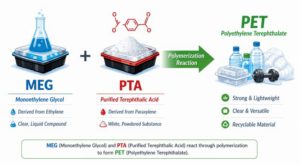
At its core, PET is made by combining two chemical ingredients, PTA (Purified Terephthalic Acid) and MEG (Mono Ethylene Glycol), which react to form the PET polymer. That reaction is the foundation.
What Is APET, and Is It Just Regular PET with Extra Letters?
Pretty much, yes. APET stands for “amorphous PET,” which means PET in its natural, non-crystallized state…so it’s clear (more on this to come). Most packaging labeled “PET,” like bottles, clamshells, and deli containers, is technically APET. It just doesn’t bother advertising it.
So when a customer specifies APET and your product is made from clear PET sheet, you’re almost certainly speaking the same language. The distinction matters more in technical spec sheets than in real-world sales conversations.
What Is CPET and When Do You Actually Need It?
 CPET, or crystalline PET, is a different animal entirely. Where APET is clear and flexible, CPET is typically opaque (often black), heat-resistant, and designed for oven or dual-oven food applications.
Here’s the short version of how it’s made (and trust us, we’re saving you a massive chemistry lesson): You start with regular APET, then force stress into it — either physically or with additives called nucleating agents. That stress tangles up the polymer chains. Tangled chains mean tougher material that won’t warp at high temperatures. The trade-off: It gets cloudy, which is partly why CPET tray manufacturers make them black or colored. The other main reason is aesthetic, as food is perceived as “popping” when packed in black.
Here’s something many people don’t realize: CPET always starts as APET.
APET can go through an extra step called crystallization, which turns it into CPET. This is what gives CPET its heat resistance and strength, but also its cloudy or opaque appearance.
That change is permanent. Once PET becomes crystallized, it can’t go back to being clear APET.
So what does that mean for recyclability?
- APET (clear PET) is widely accepted in recycling streams
- CPET (crystallized PET) can be more challenging to recycle in traditional systems because of its structure and appearance
A simple rule is that if your food goes into an oven, you need CPET. If it stays cold or sits on a shelf, APET or DPET (yes, we’re getting to what this is shortly) will do the job just fine.
What Is DPET and How Is It Different from APET?
Here’s where it gets genuinely interesting, and we’re going to try to keep it as simple as possible. The “D” in DPET stands for “direct to PET,” and it’s a quiet revolution in PET manufacturing that most people outside thermoforming (shaping plastics with heat) have never heard of. It’s also a proprietary blend.
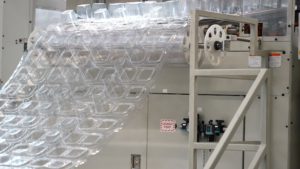
Standard APET goes through several production steps after the reactor. DPET skips all of that and goes straight from the melt phase to sheet. Think of it as subway stops — standard APET takes more stops to get where it’s going; DPET takes fewer.
Fewer steps mean less energy, a lower carbon footprint, and a higher intrinsic viscosity (a measure of material purity and strength — more on that below).
The key takeaway here: all DPET is APET — but not all APET is DPET.
Both APET and DPET are amorphous, meaning they deliver the same clear appearance and performance for cold food packaging.
So what’s the difference?
DPET isn’t a different material — it’s a more efficient way of producing APET.
What this means for you:
- If a customer specifies “APET,” DPET still meets that requirement
- You’ll get the same clarity and functionality
- You won’t be able to tell the difference visually; confirming it would require lab testing
You won’t see “DPET” printed on packaging. It’s inside-baseball terminology for a tight circle of thermoformers (we’re kind of a cool crowd with fun lingo). But if your supplier uses it, it’s a sign of a more advanced material with a better sustainability profile.
What Is Intrinsic Viscosity and Why Do Packaging Buyers Need to Know It?
Intrinsic viscosity (IV) is a single number that captures a material’s melting point, crystallinity, and tensile strength all at once. The higher the IV, the stronger and purer the material.
Because IV reflects material strength and structure, it also tells you something important about recycled content.
IV drops each time PET is recycled. That doesn’t make recycled material unusable, but it does mean performance can vary depending on how the material was sourced and processed.
What this means for you:
- Virgin PET tends to have more consistent IV
- rPET quality can vary, so sourcing matters (we’re getting to what this is)
- IV becomes a practical way to compare options and avoid performance issues, especially when evaluating recycled content
What is rPET, and Does Recycled Content Compromise Performance?
 rPET is recycled PET — made from collected bottles, clamshells, or post-consumer thermoform sheet. It’s the same molecule as PET, just with a past life. And like most things with history, it has trade-offs. For instance, it has a lower IV than virgin PET and may not deliver the same strength.
High-quality rPET suppliers work hard to compensate, and for many food packaging applications, rPET performs well. But it’s worth understanding what you’re working with before making sustainability commitments.
What Is rDPET and Where Does It Come From?
rDPET, or recycled direct to PET, is recycled DPET. It’s rare, tightly controlled, and comes almost entirely from a single producer’s closed-loop system. Because DPET starts with higher-quality material, it tends to hold up better when recycled than standard PET.
That’s what makes rDPET unique — it can deliver more consistent performance, such as strength and durability, compared to typical rPET, even with recycled content. That said, availability is limited. rDPET is a specialized material, usually tied to tightly-controlled operations.
Which Type of PET Does Your Food Application Actually Need?
We know this has been a lot of information, so let’s get resin-able (again, let us have the joke).
Here’s a straightforward summary you should know:
- Clear, cold, or ambient packaging (clamshells, deli trays, produce containers): APET or DPET
- Oven-ready or dual-oven trays: CPET
- Recycled content goals: rPET or rDPET
- Sustainability performance + lower carbon footprint: DPET or rDPET where available
The right material depends on your application, your customers’ specs, and your sustainability commitments. These aren’t interchangeable choices, but now you know the difference between them.
And the next time a customer asks whether your packaging is APET, CPET, DPET, or UNICORN-PET (just having fun, here), you’ll have something better than a long pause ready to go.
Do you want to learn more about plastic food packaging? Visit our Learning Center today and explore a wide range of topics.
Would you like to know more about Conor Carlin and his work at Clefs Advisory LLC? Connect with him on LinkedIn today.